“The Snoring is So Loud!”… When to Worry
It’s a familiar story in many Pomona households. The gentle quiet of the Noosa Hinterland night is broken by a sound that’s anything but. It often starts with a nudge from an exhausted partner. “You’re snoring again!”
For many, snoring is simply a noisy nuisance. But for a significant number of Australians, that loud, rattling sound can be a critical warning sign for a much more serious, silent health condition: Obstructive Sleep Apnoea (OSA).
The problem is, it’s impossible to tell the difference from the outside.
As your local Pomona dentist, we see the downstream effects of sleep-disordered breathing every single day, often etched into the teeth themselves. But our role goes beyond just fillings. We are a key part of your primary healthcare team, and identifying the signs of sleep apnoea is one of the most important things we do.
This guide will help you understand the difference between simple snoring and sleep apnoea, the serious health risks of leaving it untreated, and how our dental clinic in Pomona can be your first step toward a safer, quieter, and more restful night’s sleep.
Is it “Just Snoring” or is it Sleep Apnoea?
Understanding the difference is the first and most critical step. Both happen in the airway, but for very different reasons.
What is Simple Snoring?
Snoring is a sound. It’s the noise caused by the tissues in your throat (like your soft palate, tongue, and uvula) relaxing and vibrating as air passes over them. It can be caused by:
-
Your natural anatomy
-
Sleeping on your back
-
Nasal congestion from allergies
-
Drinking alcohol before bed
While it can be a major relationship stressor, simple snoring does not involve stopping breathing.
What is Obstructive Sleep Apnoea (OSA)?
Obstructive Sleep Apnoea is a medical condition. It’s not just a sound; it’s a physical event.
With OSA, the same tissues in the throat relax so much that they completely collapse and block your airway. This blockage stops you from breathing for 10 seconds or more, over and over, all night long.
Your brain, starved of oxygen, jolts you partially awake with a surge of adrenaline to force your airway open. This often results in a loud gasp, choke, or snort. You then fall back asleep, and the cycle repeats—sometimes hundreds of times a night.
The person with OSA is almost never aware this is happening. All they know is that they wake up feeling exhausted, no matter how long they were “in bed.”
The Telltale Signs: When to Suspect OSA
Ask yourself or your partner about these common warning signs:
-
Loud, persistent snoring (the most obvious sign)
-
Witnessed pauses in breathing, followed by gasping or choking
-
Waking up unrefreshed (the #1 symptom)
-
Constant daytime sleepiness (e.g., falling asleep at your desk or, dangerously, while driving)
-
Morning headaches
-
Waking up with a very dry mouth or sore throat
-
Trouble with concentration, memory, or irritability
-
High blood pressure (especially if it’s difficult to control)
If these symptoms sound familiar, it’s time to take it seriously.
Why You Can’t Ignore Sleep Apnoea: The Health Risks
This is where our team at Noosa Hinterland Dental becomes so passionate. We must move the conversation from “snoring is annoying” to “sleep apnoea is dangerous.”
When your body is starved of oxygen and flooded with adrenaline all night, it puts immense strain on your entire system. Untreated OSA is directly linked to a list of serious, life-altering health problems:
-
High Blood Pressure (Hypertension)
-
Heart Attack and Stroke
-
Type 2 Diabetes
-
Atrial Fibrillation (AFib)
-
Depression and Anxiety
-
Increased risk of workplace or driving accidents due to fatigue
This is not just about getting a better sleep; it’s about protecting your long-term health.
How Can a Dentist Help with a Sleep Problem?
This is a very common question. Why see a dentist for sleep apnoea?
Your dentist is often the first health professional who can spot the signs, sometimes before you even feel the symptoms.
1. We Are “Front-Line Screeners”
When we look in your mouth during a regular check-up, we are looking at your entire airway. We can see:
-
A large tongue or tonsils
-
A narrow-looking airway or “low” soft palate
-
Redness and irritation in the throat (from snoring and gasping)
-
Excessive, flat wear on your teeth from bruxism (grinding). Clenching and grinding are often a subconscious reflex as your body tries to pull the jaw forward to open your airway.14
2. We Are Part of a Trusted Medical Team
This is the most important point for E-E-A-T. Dentists do not diagnose sleep apnoea. This is a medical condition that requires a formal diagnosis from a qualified sleep specialist or GP.15
Our role is to:
-
Screen you for the risk factors.
-
Refer you to your GP, who will then refer you for a formal sleep study (either at home or in a lab).
-
Treat you once you have a diagnosis.
Any dentist offering to “fix” your sleep apnoea without a formal sleep study is not following best-practice guidelines. We work with your doctor to ensure you get the right diagnosis and the right treatment.
The Dental Solution: Mandibular Advancement Splints (MAS)
For many patients diagnosed with mild-to-moderate sleep apnoea, a custom-fitted dental appliance is the gold-standard treatment.
It is also an excellent and highly effective alternative for patients with severe apnoea who cannot tolerate their CPAP machine.
This device is called a Mandibular Advancement Splint (MAS).
What is a MAS and How Does it Work?
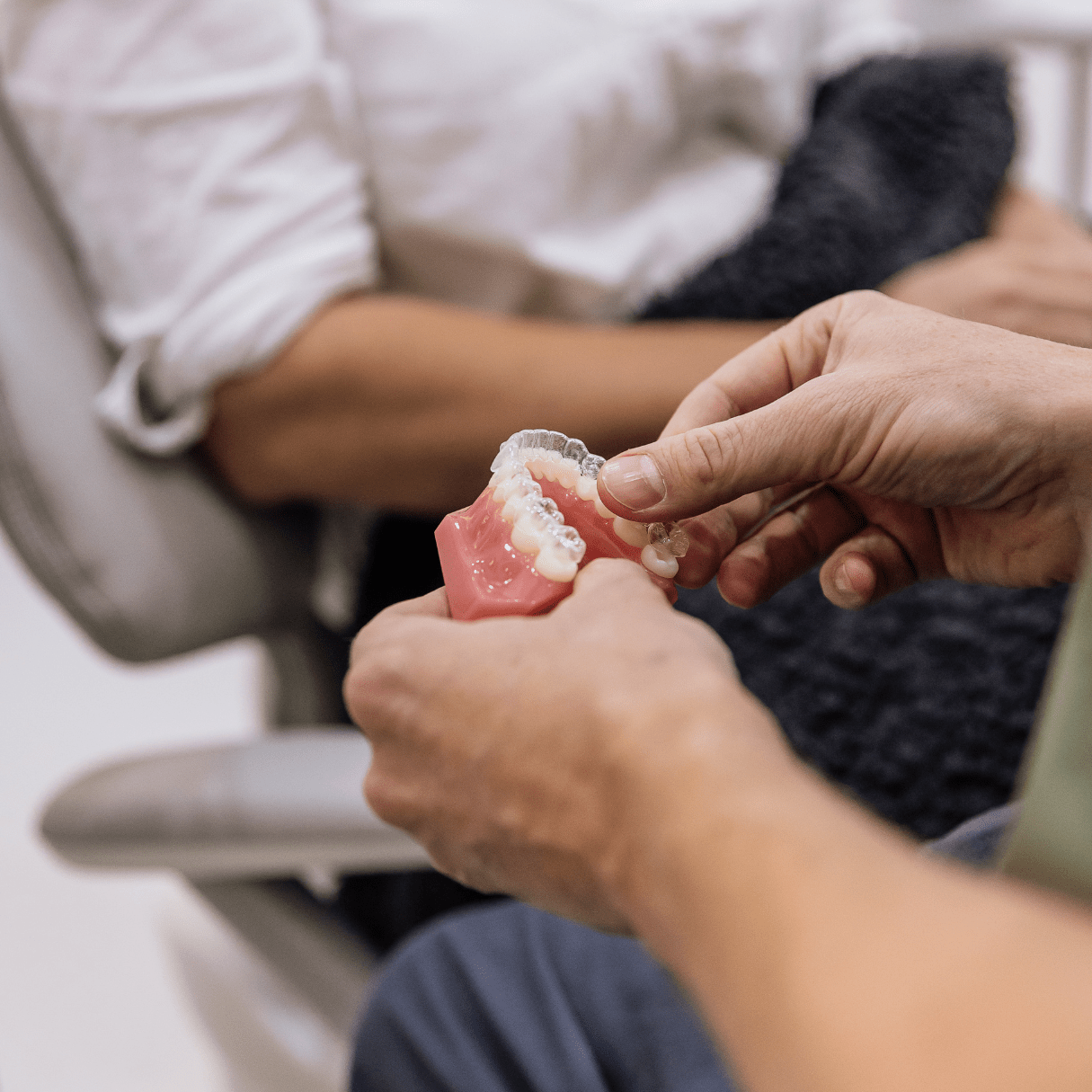
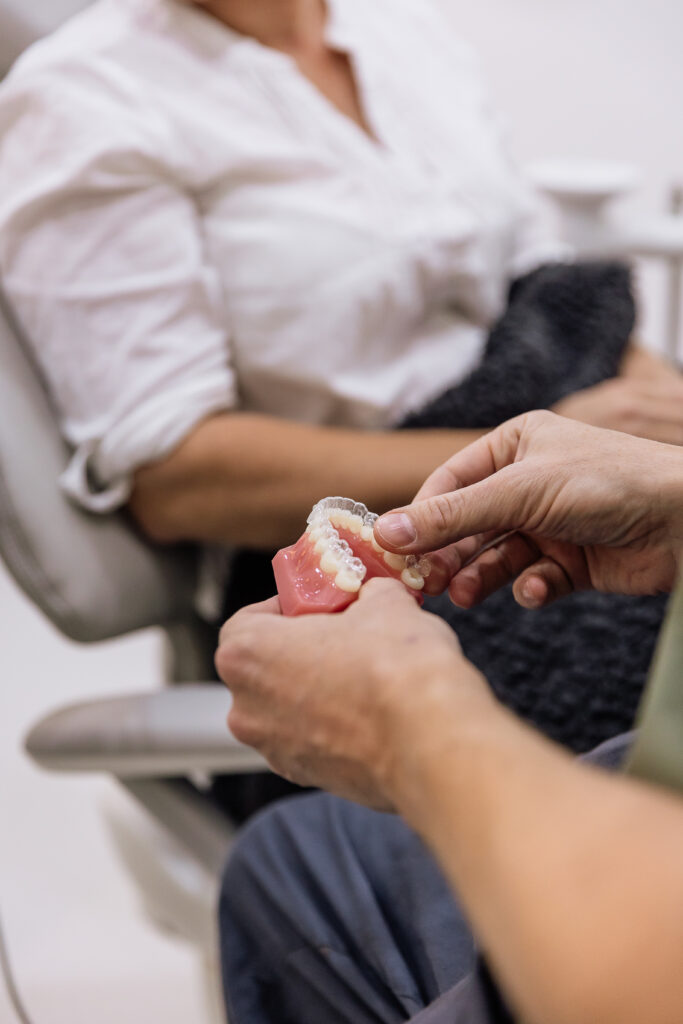
A MAS is a custom-made oral appliance that looks a lot like two high-tech mouthguards, one for your top teeth and one for your bottom. They are precision-engineered to clip together.
When you wear it at night, the MAS gently positions your lower jaw (mandible) slightly forward.
This simple forward movement pulls your tongue and the soft tissues at the back of your throat away from the airway. It mechanically holds your airway open while you sleep, preventing it from collapsing.
The result? Air flows freely. No blockage. No apnoea. No snoring.
MAS vs. CPAP vs. “Boil-and-Bite” Guards
| Feature | Custom-Fitted MAS (from a Dentist) | CPAP Machine | Over-the-Counter “Boil-and-Bite” Guards |
| How it Works | Gently holds the lower jaw forward to open the airway. | Delivers continuous pressurised air via a mask to keep the airway open. | A soft plastic guard that claims to move the jaw. |
| Best For… | Mild-to-moderate OSA. CPAP-intolerant patients. | Severe OSA (the gold standard). | Simple snoring (at best). Not safe for undiagnosed OSA. |
| Pros | Comfortable, discreet, silent, easy to travel with, easy to clean. | Highly effective for all levels of OSA. | Cheap. |
| Cons | Higher initial cost. Not for severe OSA (unless CPAP intolerant). | Bulky, noisy, can be uncomfortable (mask, dry nose), requires power. | Ineffective, poor fit, can damage teeth/jaw joint (TMD). Can make apnoea worse. |
A Critical Warning: Please do not buy a cheap, boil-and-Bite guard online to treat your snoring. If you have undiagnosed sleep apnoea, these devices can be dangerous, as they are not precise and may not work, all while giving you a false sense of security.
What to Expect: Your Sleep Journey at Noosa Hinterland Dental
We make the process simple, gentle, and collaborative.
Step 1: The Consultation & Screening
You’ll sit down with our dental team in our Pomona clinic. We’ll listen to your concerns (and your partner’s!). We’ll ask you to fill out a simple questionnaire (like the Epworth Sleepiness Scale) and perform a thorough examination of your teeth, jaw, and airway.
Step 2: The Medical Referral
If we see the signs of OSA, we will write a referral letter to your GP. We will work with them to get you a referral for a formal sleep study. This is the only way to get a proper diagnosis.
Step 3: The Diagnosis
Your sleep specialist will analyse your study and provide a formal diagnosis, including the severity of your sleep apnoea (your “AHI” score).
Step 4: The Treatment Plan
If you are diagnosed with mild-to-moderate OSA, or you are diagnosed with severe OSA but cannot tolerate CPAP, your doctor will prescribe an oral appliance. This is when you return to us.
Step 5: The Custom Fitting
We will take highly accurate 3D digital scans or moulds of your teeth. These are sent to a specialised dental lab that fabricates your bespoke Mandibular Advancement Splint. This is not a one-size-fits-all device; it is made only for you.
Step 6: The Fit Appointment & Follow-Up
When your appliance is ready, you’ll return for a fitting. We will show you how to use it, clean it, and make tiny adjustments for maximum comfort and effectiveness. We will follow up with you to ensure it’s working and that your jaw is comfortable.
Frequently Asked Questions About Snoring & Sleep Apnoea
Q: Will a dental splint be comfortable to sleep with?
A: Because our splints are custom-made from high-grade, thin materials, most patients find them very comfortable. There is an adjustment period of a few nights, but this is far easier than adjusting to a CPAP mask for most people.
Q: Will this fix my snoring?
A: For most patients, yes. By opening the airway and stabilising the jaw, the splint stops the tissues from vibrating, which is the cause of snoring. This often makes partners very happy!
Q: Is a Mandibular Advancement Splint covered by my private health fund?
A: Often, yes. Many major health funds recognise MAS as a medical device for treating diagnosed sleep apnoea. Coverage will depend on your specific fund and level of cover (often under “Major Dental” or a specific “Sleep Apnoea” category). We can provide you with the item numbers to check with your fund.
Q: How long will the appliance last?
A: With proper care, a high-quality, custom-made MAS will last for many years (typically 3-5 years or more).
Your Action Plan for a Better Night’s Sleep
If this article has raised any red flags for you, please don’t wait.
-
Talk to Your Partner: Ask them honestly what they hear at night. Do you just snore, or do they hear you stop breathing, gasp, or choke?
-
Talk to Your GP: Discuss your symptoms—especially fatigue and snoring—and ask for a referral for a sleep study. This is a vital step.
-
Talk to Us: Book a sleep consultation at our Pomona dental clinic. We can screen you for the oral signs of OSA and be ready to act as soon as you have your diagnosis.
Start the Conversation with Your Pomona Dentist Today
A quiet night’s sleep and a healthier life are possible. You don’t have to live with constant exhaustion.
At Noosa Hinterland Dental, we are passionate about helping our community in Pomona, Cooroy, and the entire Sunshine Coast hinterland breathe easier. We provide a gentle, non-judgemental, and expert environment to start this important health conversation.
Call our friendly Pomona team today or book your sleep consultation online.