
Wisdom Teeth Assessment and Removal at Noosa Hinterland Dental
At Noosa Hinterland Dental in Pomona, we provide wisdom teeth assessments and extractions where clinically appropriate.
Wisdom teeth, also known as third molars, are the last permanent molars to develop. They commonly emerge during late adolescence or early adulthood, although their position and development vary between individuals.
Some wisdom teeth develop without causing problems and may not require removal. Others may become impacted, develop decay or contribute to infection and damage to nearby teeth or gum tissues.
Our dentists assess your oral health, symptoms and relevant imaging before discussing whether monitoring, treatment or extraction may be appropriate.
Wisdom teeth removal is a surgical procedure with potential risks and complications. We explain the proposed treatment, available alternatives, recovery considerations and costs before proceeding.
Why Might Wisdom Teeth Need Removal?
Wisdom teeth do not automatically require extraction.
Removal may be recommended when clinical assessment identifies problems such as:
- Recurrent pain or infection associated with a wisdom tooth.
- Decay affecting a wisdom tooth that cannot be appropriately restored.
- Damage or decay involving an adjacent tooth.
- Repeated inflammation around a partially erupted wisdom tooth.
- Cysts or other pathology associated with the tooth.
- Certain clinical circumstances where removal forms part of another necessary treatment plan.
Some wisdom teeth are impacted, meaning they have not fully emerged into the mouth. However, impaction alone does not necessarily mean a tooth requires removal.
Wisdom teeth that are healthy and not causing problems may be monitored through dental examinations and appropriate imaging where clinically indicated.
Your dentist will explain the findings and whether extraction, monitoring or another approach is recommended.


What Does Wisdom Teeth Removal Involve?
The process begins with a dental examination and discussion of your medical history, medications, current symptoms and previous dental treatment.
Dental X-rays may be recommended to assess the position of the wisdom teeth, the surrounding bone and their relationship to nearby anatomical structures.
In selected cases, 3D CBCT imaging may be considered when additional anatomical information is clinically required.
If extraction is recommended, your dentist will explain whether the tooth can be removed through a relatively straightforward procedure or whether a more complex surgical approach may be necessary.
Surgical removal of an impacted wisdom tooth can involve an incision in the gum, removal of some surrounding bone and division of the tooth into sections.
Local anaesthesia is commonly used. Sedation options may also be discussed where clinically appropriate.
Some complex cases may require referral to an oral and maxillofacial surgeon or another suitable service.
What Can I Expect During Recovery?
Recovery following wisdom tooth removal varies depending on the tooth’s position, the complexity of surgery and individual healing factors.
Temporary discomfort, swelling, bruising, minor bleeding and difficulty opening the mouth may occur.
Your dental team will provide postoperative instructions covering oral hygiene, food and drink, activity restrictions and any recommended medications.
Potential complications include infection, delayed healing, dry socket, damage to neighbouring teeth, sinus complications and nerve injury that may cause temporary or occasionally permanent changes in sensation.
Some patients recover sufficiently to resume usual activities within several days, while others may need longer.
Contact your dental practitioner if you develop increasing pain, persistent bleeding, fever or worsening swelling. Severe swelling affecting breathing or swallowing requires immediate emergency medical attention.
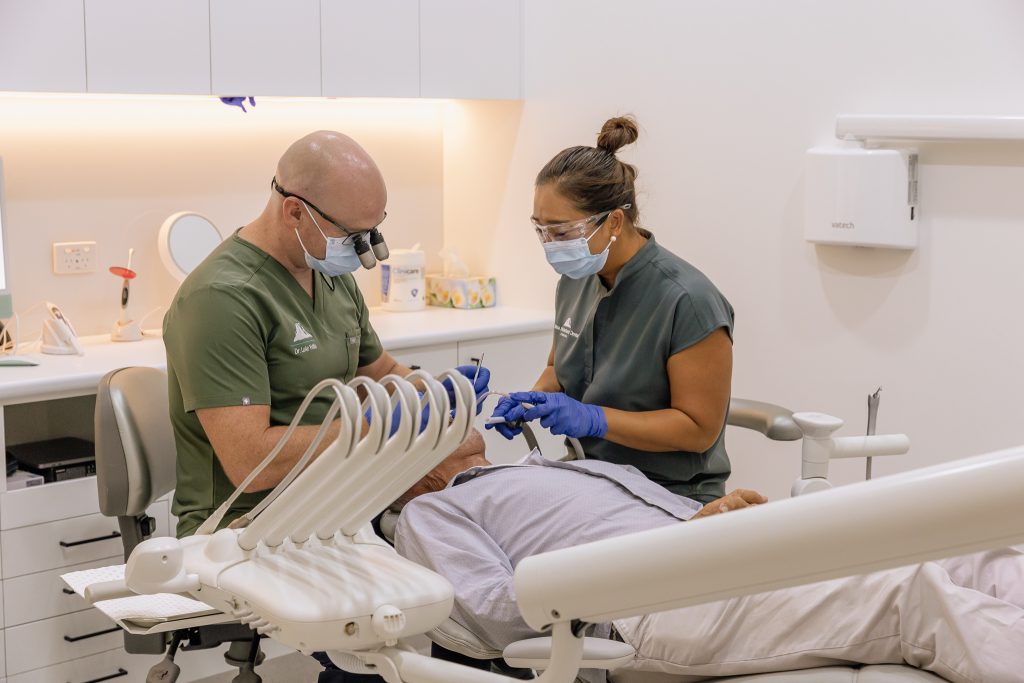
Wisdom Teeth Removal and IV Sedation on the Sunshine Coast
Some patients experience anxiety about wisdom tooth extraction or have concerns about undergoing a surgical dental procedure.
At Noosa Hinterland Dental in Pomona, we can discuss available anaesthetic and sedation arrangements as part of treatment planning.
IV sedation may be considered for selected patients following an appropriate medical and dental assessment.
Sedation involves administering medications that reduce awareness or anxiety during treatment. The effects vary according to the medications used, dosage and individual response.
IV sedation is not the same as general anaesthesia and does not guarantee that a patient will be unconscious, have no memory of treatment or experience no discomfort.
Local anaesthesia is commonly required to manage pain during extraction, even when sedation is used.
Sedation also carries potential risks, including breathing difficulties, changes in blood pressure, prolonged drowsiness and adverse medication reactions.
Your treating practitioner will explain the relevant preparation, monitoring, escort and recovery requirements if sedation is being considered.
What Are Wisdom Teeth?
Wisdom teeth are the third molars located at the back of the upper and lower jaws.
They generally develop later than other permanent teeth and may emerge during late adolescence or early adulthood.
Some wisdom teeth erupt into a position where they can be cleaned and maintained. Others remain partially or fully covered by gum tissue or bone.
The position of a wisdom tooth can make cleaning difficult and may contribute to decay, gum inflammation or infection in some patients.
A dental examination can help determine whether monitoring or treatment is appropriate.
Why Remove Wisdom Teeth?
Wisdom teeth removal may be considered where there is a clinical reason, such as recurring infection, decay, damage to adjacent teeth or other identified pathology.
However, extraction is not necessarily recommended for every impacted or unerupted tooth.
Decisions about removal consider the tooth’s position, current symptoms, future clinical risks and the possible complications of surgery.
Your dentist will discuss whether the expected benefits of extraction outweigh the risks in your individual circumstances.
IV Sedation for Wisdom Teeth Removal
IV sedation may be an option for some patients undergoing wisdom tooth extraction.
It involves administering medication through a vein under appropriate clinical supervision and monitoring.
Depending on the sedation technique, patients may experience drowsiness, reduced anxiety and altered awareness.
However, individual responses vary, and memory loss or complete relaxation cannot be guaranteed.
Before IV sedation, a clinical assessment is required to determine suitability and discuss the relevant medical considerations.
Patients may need to follow fasting instructions and arrange for a responsible adult to accompany them home.
Driving and other activities may be restricted following sedation.
Not every patient requires sedation, and it may not be appropriate for those with certain medical conditions or other risk factors.
Your dental team can explain the available approaches, including treatment under local anaesthesia alone or referral where appropriate.
Frequently Asked Questions About Wisdom Teeth
Wisdom teeth may require removal when they cause problems such as recurring infection, decay, damage to adjacent teeth or other clinically significant conditions.
Healthy wisdom teeth that are not causing problems may be monitored rather than removed.
There is no single age at which everyone should have their wisdom teeth extracted.
Local anaesthesia is commonly used to help manage pain during wisdom tooth extraction.
Patients may experience pressure or other sensations during the procedure, and discomfort can occur afterwards.
The degree of discomfort depends on the complexity of extraction and individual response.
Your dentist will discuss appropriate pain-management options and postoperative care.
Recovery times vary.
Swelling, tenderness and jaw stiffness may occur during the first several days, and some patients require more time before returning to usual activities.
Healing of the extraction site continues beyond the initial recovery period.
Your dentist will explain the expected recovery considerations based on the proposed procedure.
Some wisdom teeth remain healthy without causing problems.
Others may develop decay, infection, gum inflammation or damage to adjacent teeth.
The likelihood of complications depends on the position and condition of the tooth and other individual factors.
Your dentist can explain whether monitoring or removal is appropriate.
Possible risks include pain, swelling, bleeding, infection, dry socket, damage to adjacent teeth and delayed healing.
Upper wisdom tooth removal may involve sinus-related complications.
Lower wisdom tooth surgery can involve injury to nearby nerves, potentially causing altered sensation in the lip, chin or tongue. These changes may occasionally be permanent.
Your dentist will explain the risks relevant to your individual case before treatment.
Your dentist will provide instructions about managing bleeding, oral hygiene, food and drink, medications and activity restrictions.
You may be advised to avoid smoking, vigorous rinsing and certain activities during the early healing period.
Contact the practice if symptoms are unexpected, severe or worsening.
Discuss Wisdom Teeth Removal in Pomona
If you have concerns about wisdom teeth, pain at the back of your mouth or a recommendation for extraction, Noosa Hinterland Dental can provide a dental assessment.
Our Pomona practice welcomes patients from Cooroy, Cooran and surrounding Noosa Hinterland and Sunshine Coast communities.
An appointment provides an opportunity to discuss whether monitoring, wisdom tooth removal or referral may be appropriate, including the potential benefits, risks, alternatives and costs.