Wisdom teeth do not always need to be removed. Many sit comfortably in the mouth for life when they are healthy, painless, and easy to clean. Removal is recommended only when problems or future risks are found during a professional assessment with examination and X‑rays at clinics such as Noosa Hinterland Dental.
Understanding Wisdom Teeth And Whether They Always Need Removal
Stories about wisdom teeth often sound dramatic. Someone’s face swelled up before a big event, or a friend needed all four teeth out in one visit. It is no surprise that many people in the Noosa Hinterland feel nervous as soon as a dentist mentions wisdom teeth.
These teeth, also called third molars, usually start to appear between the late teens and mid twenties. They sit right at the back of the mouth, behind the last chewing teeth, in an area that can be hard to see and even harder to keep clean every day.
Many people are told that removal is automatic once wisdom teeth appear. Modern dentistry takes a gentler, more thoughtful approach. In many mouths these teeth can stay in place safely, while in others they are better removed to prevent pain, infections, or damage to nearby teeth.
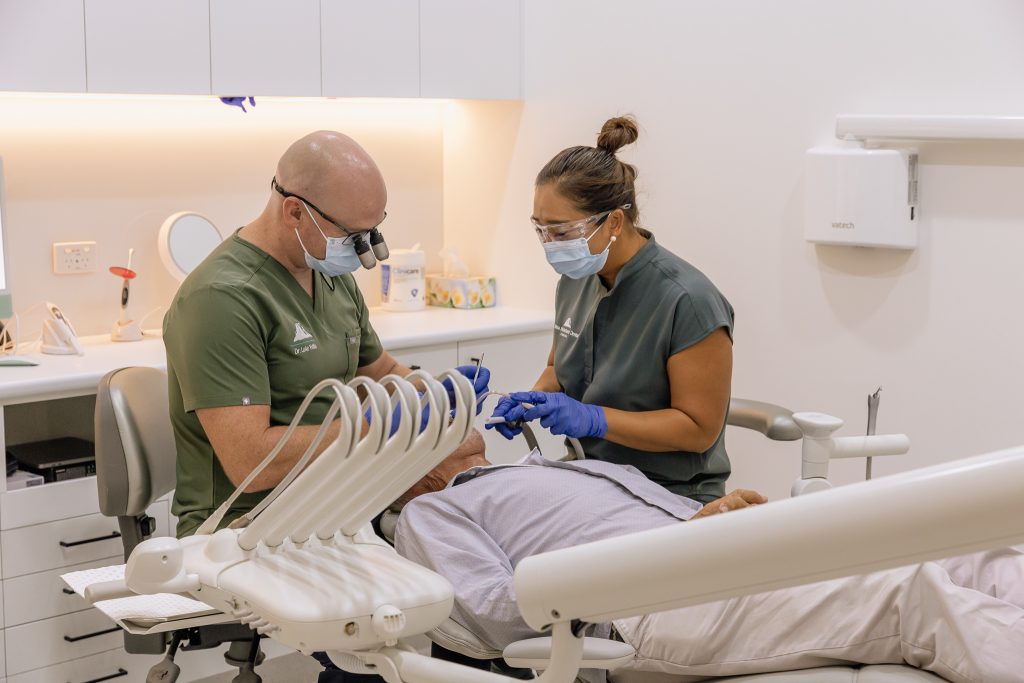
In a careful assessment, the dentist looks at how the wisdom teeth are growing, whether there is enough room, and what the long term risks might be. This includes a gentle examination, X‑rays, and a clear chat about symptoms and future plans. At Noosa Hinterland Dental in Pomona, this process is calm, unhurried, and focused on what feels right for each individual, with care.
“The best dentistry is often about deciding when not to treat, just as much as when to treat.” – Prof. I. Needleman, University College London
Key Takeaways
Before diving into the details, it helps to see the main points at a glance. These short takeaways give a quick guide to how wisdom teeth are assessed. They also show when removal may help and when watching and waiting is perfectly safe.
-
Wisdom teeth do not always need removal. They can often stay in place when they are healthy, painless, and easy to clean. A dentist checks this during regular visits.
-
Warning signs include pain, swelling, repeated infections, bad taste, jaw stiffness, or crowding near the back teeth. These changes mean the wisdom teeth might be causing trouble. An assessment should be booked sooner rather than later.
-
X‑rays and, when needed, 3D scans help show exactly how the wisdom teeth sit in the jaw. This lets the dentist weigh up long term risks. Noosa Hinterland Dental then plans either monitoring or gentle removal together with the patient.
Do Wisdom Teeth Always Need Removal: Myth Vs Reality
For years many people have heard that wisdom teeth must come out as soon as they appear. The truth is more balanced. Dentists now look at each mouth carefully and remove wisdom teeth only when there is a clear benefit for long term health. This means the answer is different for each person rather than one rule for everyone.
The Myth: “Everyone Has To Have Their Wisdom Teeth Out”
Stories from parents, friends, and social media often make it sound like wisdom tooth removal is a rite of passage. In the past, dentists sometimes removed these teeth more routinely, especially when X‑rays were limited. Modern research supports a more careful approach, where healthy wisdom teeth are watched instead of removed straight away.
Some reasons this myth still hangs around include:
-
Friends sharing strong stories of difficult removals
-
Older advice from relatives whose teeth were removed as a precaution
-
Online posts that focus on worst‑case scenarios rather than calm, routine care
Understanding that care is now more personalised can ease a lot of worry.
When Wisdom Teeth Can Safely Stay In Place
Many wisdom teeth cause no trouble at all. If they erupt fully, line up well with the teeth above or below, and can be brushed and flossed, they may stay for life. When there is no pain, infection, or damage on X‑rays, monitoring at regular check ups is usually all that is needed.
Signs a wisdom tooth can often stay include:
-
It has fully come through the gum in a straight position
-
The gum around it looks pink and healthy
-
It can be reached with a toothbrush and floss without difficulty
-
X‑rays show no decay, cysts, or damage to neighbouring teeth
In these cases, dentists at Noosa Hinterland Dental generally recommend:
-
Six‑monthly or yearly check ups
-
Periodic X‑rays to confirm the tooth and surrounding bone remain healthy
-
Tips for brushing and flossing the back corners more effectively
When Removal Is More Likely To Be Recommended
Removal is more likely when wisdom teeth are partly trapped under gum or bone, or when they keep flaring up. Ongoing pain, swelling, or infections are clear signs that something is not right. Dentists also consider removal if decay is hard to treat, if nearby teeth are being damaged, or if X‑rays show cysts or other changes. At Noosa Hinterland Dental, these decisions are never rushed, and dentists explain why removal is advised so that patients can feel confident about the plan.
Common reasons for recommending removal include:
-
Repeated infections around a partly erupted tooth
-
Food trapping under a gum flap that is impossible to keep clean
-
Damage or deep decay on the second molar behind the wisdom tooth
-
Cysts or other changes around the wisdom tooth roots on X‑rays
-
Pain or pressure linked to the tooth pushing on others
“We’re not just taking teeth out; we’re protecting the long‑term health of the teeth you use every day.” – Dr. R. Christensen, general dentist
What Are Impacted Wisdom Teeth And Why Can They Cause Problems
One of the main reasons wisdom teeth misbehave is impaction. This means the tooth does not have a clear path to come through the gum into its normal position. Understanding this idea makes it easier to see why some wisdom teeth cause trouble while others stay quiet.
What “Impacted” Wisdom Teeth Actually Means
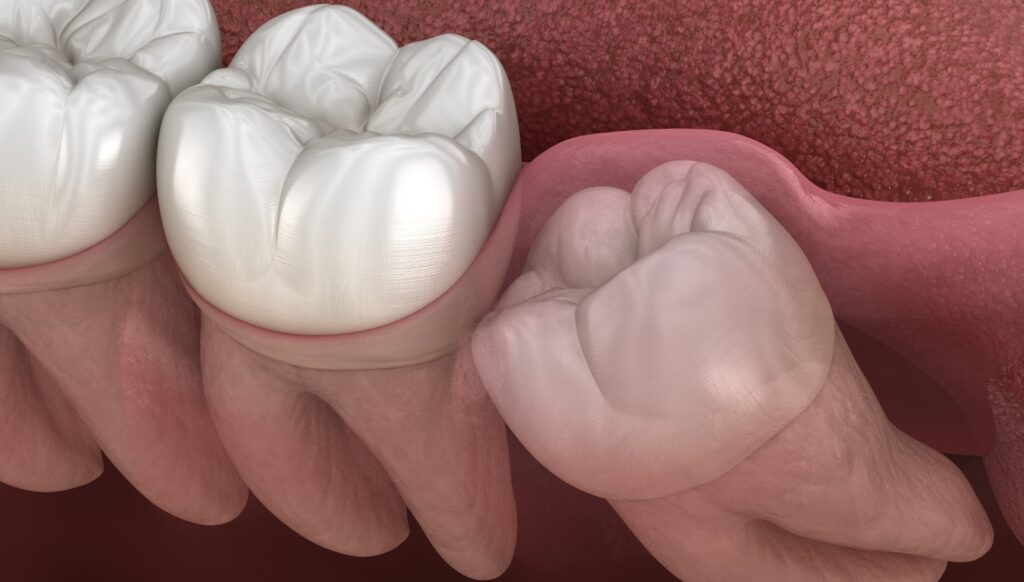
An impacted wisdom tooth is one that cannot fully break through the gum or sit in a healthy position. Often there is simply not enough space at the back of the jaw. Sometimes the tooth is tilted forward, backward, or sideways, or it is completely covered by bone.
Some impacted teeth are partly visible in the mouth with a small flap of gum over the top. Others never appear at all and can only be seen on X‑rays. Dentists in Pomona and Cooroy often find these hidden teeth during routine checks in the late teenage years.
Common types of impaction include:
-
Mesio‑angular impaction – the tooth leans toward the front of the mouth
-
Disto‑angular impaction – the tooth leans toward the back of the mouth
-
Vertical impaction – the tooth is upright but trapped under the gum or bone
-
Horizontal impaction – the tooth lies sideways against the neighbouring tooth
Each pattern carries different risks, which is why accurate X‑rays are so important.
Common Symptoms And Warning Signs Of Troubled Wisdom Teeth
Common early signs of wisdom tooth trouble include:
-
A dull ache or pressure at the back of the jaw
-
Tender gums or discomfort when chewing on one side
-
Red or swollen gum behind the last molar
-
Food catching in this area very easily
-
Bad taste, bad breath, or jaw stiffness when opening wide
Emergency symptoms are less common but need fast attention. These include:
-
Severe pain not eased by usual pain relief
-
Swelling that spreads into the cheek, jaw, or neck
-
Fever or feeling unwell
-
Any difficulty swallowing or breathing
Anyone with these signs should contact a dentist or doctor straight away.
Risks Of Leaving Problematic Wisdom Teeth Untreated
Problematic wisdom teeth rarely settle on their own. Repeated infections can scar the gum and make each flare up more painful. Over time, decay, gum disease, or cysts around the tooth can damage the second molar and the jawbone, sometimes leading to the loss of more than one tooth.
Potential long term risks include:
-
Chronic gum infections (pericoronitis)
-
Spread of infection into the cheek or neck spaces
-
Deep decay in hard‑to‑reach areas between teeth
-
Bone loss around the roots of nearby molars
-
Cyst formation around the impacted tooth
Addressing these problems earlier often leads to simpler treatment and a smoother recovery.
What Happens At A Wisdom Teeth Assessment
Step 1: Talking Through Your Symptoms, Health, And Concerns
The appointment usually starts with a conversation rather than instruments. The dentist asks when symptoms began, how often they appear, and what makes them better or worse. They also ask about past dental work such as braces, fillings, implants, or dentures, along with any medical conditions and medications.
This is also a chance to talk openly about:
-
Any worries about pain or injections
-
Past dental experiences that were difficult
-
Timing needs around school, work, or sport
-
Preferences about treatment in the chair versus under deeper sedation
Step 2: Gentle Examination Of Your Wisdom Teeth And Gums
The next step is a gentle look inside the mouth. The dentist checks:
-
How far the wisdom teeth have come through
-
Whether there are gum flaps trapping food
-
If there is any redness, swelling, or pus
-
How wide the mouth opens
-
How the top and bottom teeth meet when biting together
Most people find this part quick and painless. If anything feels uncomfortable, the dentist can pause, explain what they see, and adjust the pace so even anxious patients stay as relaxed as possible.
Step 3: Advanced X‑Rays And 3D Imaging If Needed
Because wisdom teeth sit deep in the jaw, X‑rays are an important part of the assessment. Noosa Hinterland Dental uses low dose digital radiography, which gives clear images with much less radiation than older film X‑rays. These pictures show the angle of each wisdom tooth and how close it is to nearby roots and nerves.
For complex cases, the dentist may recommend a 3D CBCT scan. This scan creates a detailed three dimensional view of the jaw so that the exact position of the tooth, the nerve canal, and the sinuses can be seen. The scan is quick, and patients simply stand or sit still while the machine moves gently around the head.
A short comparison of imaging tools often used:
| Imaging Type | What It Shows | When It’s Used |
|---|---|---|
| Bitewing X‑rays | Crowns of back teeth, decay between teeth | Routine check ups |
| OPG (panoramic) | All teeth, jaw joints, general wisdom tooth position | First overview of wisdom teeth |
| CBCT 3D scan | Detailed 3D view of roots, nerves, sinuses | Complex or high‑risk wisdom tooth removal |
Step 4: Deciding Between Monitoring And Removal Together
Once all the information is gathered, the dentist explains what it means in everyday language. Together you talk about options, such as:
-
Monitoring with regular check ups
-
Managing minor flare ups with cleaning and rinses
-
Planning removal of one or more wisdom teeth
Time is given for questions so the final decision feels comfortable and well informed. If removal is advised, the team at Noosa Hinterland Dental can outline whether this is best done:
-
In the dental chair with local anaesthetic
-
With added oral sedatives or IV sedation for anxiety
-
In a hospital setting if full general anaesthetic is required
If Removal Is Recommended: What To Expect Without The Scare Factor
Gentle, Well Planned Wisdom Tooth Removal
Many wisdom teeth can be removed comfortably in the dental chair. After numbing gel is placed, local anaesthetic is given so the area feels numb and free from sharp pain. The dentist then gently loosens the tooth, sometimes making a small opening in the gum or dividing the tooth into smaller pieces so it can be lifted out with less pressure on the jaw.
To keep the experience as smooth as possible, dentists generally:
-
Test the area to confirm it is fully numb before starting
-
Talk through what you may feel (pressure, movement, but not sharp pain)
-
Work in stages, checking in regularly
-
Place stitches if needed to support healing
“Patients remember how they felt more than what we did. A calm, well‑explained appointment is just as important as clinical skill.” – Dr. M. G. McKernan, oral surgeon
Support For Anxious Patients: Sedation And Gentle Care
Feeling worried about wisdom teeth is very common, especially for those who have had painful dental visits before. Noosa Hinterland Dental takes time to explain each step, check in regularly, and use calming techniques so patients feel respected and heard. For extra support, options such as oral sedatives or IV twilight sedation may be offered after a thorough safety check.
Helpful strategies for nervous patients include:
-
Arriving early so there is no rush
-
Bringing headphones and calming music or podcasts
-
Agreeing on a hand signal to pause treatment
-
Scheduling longer appointments with more breaks
Sedation does not replace good communication but can make the visit far more manageable for those with strong anxiety.
Recovery, Aftercare, And When To Call For Help
Most people feel some soreness and swelling for the first few days, which then improves steadily. Cold packs, prescribed or recommended pain relief, and soft foods such as yoghurt, soups, and mashed vegetables all make this stage easier. Dentists usually suggest gentle salt water rinses after the first day and advise avoiding smoking or drinking alcohol while the area heals.
A typical first week might look like:
-
Day 1–2: Swelling and stiffness peak; rest, cold packs, soft food
-
Day 3–4: Discomfort starts to ease; careful brushing around the area
-
Day 5–7: Most people feel much more normal and can resume usual routines
If pain suddenly worsens after a couple of days, or if there is ongoing bad taste, fever, or increasing swelling, the clinic should be contacted. These signs may point to a dry socket or infection, and early review helps things settle faster.
FAQs
A few common questions come up again and again during wisdom tooth visits. Here are straightforward answers that may help before a personal consultation.
Do all wisdom teeth eventually need to be removed?
No, many wisdom teeth never need removal. When they erupt fully, stay pain free, and remain easy to clean, they can often be kept for life. Regular check ups and X‑rays at Noosa Hinterland Dental help confirm they are still healthy.
How do I know if my wisdom teeth are causing problems?
Warning signs include pain or pressure at the back of the jaw, swollen or bleeding gums, bad taste, jaw stiffness, or repeated infections. Sometimes problems show only on X‑rays, so a check up is wise even if there is no pain.
What age is best to have wisdom teeth checked?
Dentists usually start monitoring wisdom teeth in the mid teens, especially before or after orthodontic treatment. Younger adults tend to heal faster and more comfortably if removal is needed, so early advice helps families plan around school, work, or travel.
I am very anxious – can I still have my wisdom teeth removed?
Yes, dental anxiety is very common and can be discussed openly. Noosa Hinterland Dental offers gentle communication, extra time, and sedation options such as oral sedatives or IV sedation when suitable. Many anxious patients are surprised by how manageable the experience feels with this support.
Will I need time off work or school after removal?
Most people prefer to rest for at least one to two days, especially after having several wisdom teeth removed. Those with physically demanding jobs or contact sports may need a little longer. Your dentist will give tailored advice based on the complexity of the procedure.
Feeling nervous about wisdom teeth removal?
👉 Talk to us about gentle care and sedation options so you can feel calm and supported every step of the way.
Conclusion
Wisdom teeth do not always need removal, and there is no single rule that suits everyone. The key is to understand how they are growing, whether they are healthy, and what might happen over time. Pain, swelling, repeated infections, or worrying X‑ray findings are strong reasons to consider treatment, while quiet, healthy teeth can often be monitored instead.
A thorough assessment with examination, low dose digital X‑rays, and, when needed, 3D scans helps guide these decisions. At Noosa Hinterland Dental in Pomona, near Cooroy and the wider Noosa Hinterland, the team focuses on gentle, individual care, including sedation for anxious patients. Booking a wisdom teeth assessment is a calm first step to find out whether the teeth can stay or whether carefully planned treatment is the best path forward. Appointments can be arranged at a time that fits everyday family life, with clear advice at every stage.