If you are considering Invisalign for teens, clear aligners can be a discreet and flexible way to straighten your teenager’s teeth without traditional metal braces. Invisalign uses removable, custom-made trays that gradually move teeth into better alignment while fitting around school, sport, music, social events and everyday life.
For many teens, it can treat crowding, spacing and some bite issues, although more complex cases may still need braces.
At Noosa Hinterland Dental in Pomona, we assess your teen’s teeth, gums, bite and daily habits before recommending Invisalign or braces, helping families choose the safest and most practical option for a healthier, more confident smile.
Jump to section
- Is Invisalign Right For Your Teen?
- What Is Invisalign For Teens?
- How Does Invisalign Treatment Work At Noosa Hinterland Dental?
- Invisalign Vs Traditional Braces For Teens
- Are Clear Aligners Suitable For Every Teen?
- Daily Life, Hygiene And Compliance: What Parents Should Know
- How Long Does Invisalign Treatment Take?
- Moving Forward With Your Teen’s Smile
- Frequently Asked Questions
Is Invisalign Right For Your Teen?
Choosing between Invisalign for teens and traditional braces can feel like a big call for any family. For many teenagers, Invisalign for teens straightens teeth as well as braces, while very complex bites still suit fixed braces more.
Stress about cost, treatment time and school or sport can make the decision even harder. Parents across Pomona, Cooroy, Cooran, Kin Kin and Imbil often want something discreet that still works.
This article explains how Invisalign for teens works, how it compares with braces, who it suits, and what treatment looks like at Noosa Hinterland Dental in Pomona. You will also see what daily life, hygiene and costs look like, plus how payment plans can help.
Keep reading to understand the benefits and limits so you can choose the safest, most practical option for your teenager’s smile.
Key Takeaways
-
Invisalign for teens uses clear, removable trays rather than fixed metal. They can treat many crowding and bite issues. Your dentist decides whether complex cases still need braces.
-
Clear aligners usually fit well around school, sport, music and casual work. Teens remove them for eating and toothbrushing. Most people barely notice them in photos or conversations.
-
Success depends on wearing aligners 20 to 22 hours a day. Braces may suit teens who struggle with routines. Noosa Hinterland Dental guides families on options and offers interest free DentiCare plans.
What Is Invisalign For Teens?
Invisalign for teens is a clear aligner system that straightens teeth with a series of custom made plastic trays. Each tray fits closely over the teeth and moves them little by little. Teen versions often include wear time indicators, space for erupting teeth and options for replacement trays.
These aligners can help with common teenage problems such as crowding, spacing, overbite, underbite, crossbite and mild relapse after past braces, with research on the correlation between transverse and sagittal dimensions highlighting how early-stage treatment with clear aligners can address multiple alignment concerns. Invisalign recommends that trays stay in for 20 to 22 hours per day for reliable movement Invisalign. At Noosa Hinterland Dental, the team checks teeth, gums and jaw growth carefully to decide whether clear aligners, braces or a mix of both offers the best path for your child.
How Invisalign For Teens Works Day To Day
Day to day, Invisalign for teens works through regular, consistent wear. Teens usually change to a new set of aligners every one to two weeks, as advised by the dentist. Trays come out only for:
-
Eating
-
Drinking anything except water
-
Cleaning teeth
Teen specific features such as wear indicators can show how closely trays are worn. Because aligners are smooth and clear, most teenagers feel comfortable wearing them at school, during part time work, sport and social events. With good habits, they become part of the routine rather than a drama.
How Does Invisalign Treatment Work At Noosa Hinterland Dental?
Invisalign treatment at Noosa Hinterland Dental starts with a full orthodontic assessment. The dentist checks tooth positions, gum health and the way the jaws meet, often using:
-
Clinical photos
-
X‑rays
-
A 3D digital scan
This information feeds into detailed computer planning, which maps out how each tooth should move.
From there, a series of aligners is made for your teenager. Review visits usually happen every six to eight weeks to check progress, supply new trays and answer questions. Orthodontics Australia notes that many orthodontic treatments run for about 18 to 24 months Orthodontics Australia, although some simpler Invisalign cases finish sooner.
The Pomona team takes extra care with anxious teens, using Tell–Show–Do, comfort items and, where needed, sedation options so visits stay calm and manageable.
From First Consultation To Retainers: Step-By-Step
At the first visit, the dentist listens to your teen’s concerns, checks teeth and gums, and takes any needed images. They explain whether Invisalign, braces or another approach best suits the mouth and lifestyle. Parents can ask about:
-
Costs and likely range
-
Payment plans
-
Expected time frames
-
What daily wear will look like
Once you decide to go ahead, digital planning turns into a full set of aligners. A fitting visit follows, where trays are checked, small tooth coloured attachments may be added and wear instructions are explained clearly. Review visits give the team a chance to guide habits and keep treatment on track.
When the final tooth positions look right, attachments come off and retainers are made. According to the American Association of Orthodontists, wearing retainers after treatment is needed to hold results for the long term American Association of Orthodontists. Noosa Hinterland Dental explains exactly how often retainers should be worn so the new smile stays stable.
“Orthodontic retention is just as important as the treatment itself.” – American Association of Orthodontists
Invisalign Vs Traditional Braces For Teens
Invisalign vs traditional braces for teens compares two ways to straighten teeth and improve bites. Both move teeth through gentle forces over time, and both can give strong cosmetic and functional results. For many mild to moderate problems, clear aligners can work as well as braces, while more complicated jaw or tooth issues still suit fixed braces better.
Clear aligners are almost invisible and are removed for meals and brushing, which many teenagers appreciate. Braces stay on the teeth, so they keep working even when a teen forgets about them. The team at Noosa Hinterland Dental offers Invisalign and braces for teenagers and helps families weigh up appearance, comfort, lifestyle, compliance and long term stability before choosing.
Comparison Table: Clear Aligners Vs Braces For Teenagers
Here is a simple side by side look at clear aligners and braces for teenagers.
| Aspect | Invisalign Style Clear Aligners | Traditional Braces For Teens |
|---|---|---|
| Appearance | Clear trays that are hard to notice in normal conversation | Metal or ceramic brackets and wires that are clearly visible |
| Comfort | Smooth plastic with fewer cheek or lip rubs | Brackets and wires can rub and may need wax at times |
| Food And Drink | Trays removed for meals, few food limits | Hard or sticky foods can damage brackets and are usually avoided |
| Oral Hygiene | Brush and floss normally with trays out | Cleaning carefully around brackets and under wires is needed |
| Compliance | Needs 20 to 22 hours wear daily | Works constantly because braces are fixed to teeth |
| Lifestyle And Sport | Often easier with mouthguards and some instruments | Extra care needed with contact sport and wind or brass music |
| Treatment Scope | Suits many mild to moderate alignment and bite issues | Handles the widest range of complex or severe cases |
| Emergency Visits | Rare problems such as lost trays | Possible broken brackets and poking wires needing repairs |
Your dentist will look at your teen’s bite, habits and goals, then guide you toward the option that offers the safest and most predictable result.
Are Clear Aligners Suitable For Every Teen?
Clear aligners such as Invisalign for teens suit many young people, but not everyone. They work well for:
-
Mild to moderate crowding or spacing
-
Many overbites and underbites
-
Crossbites and some open bites
-
Some relapse after earlier braces
Teen specific features, including options for mandibular advancement, can even help with some growing jaw problems, as supported by the Retrospective Evaluation of Invisalign® mandibular advancement outcomes in growing patients.
However, very severe crowding, large jaw size differences or multiple impacted teeth may still need braces or even specialist orthodontic care, as an evaluation of the estimated aligners needed to correct malocclusion traits illustrates how case complexity directly influences treatment planning. Aligners also depend on good habits. Teens who often misplace items or resist instructions might do better with fixed braces.
The Australian Institute of Health and Welfare reports that many Australian children have untreated tooth decay Australian Institute of Health and Welfare, so any active decay or gum disease must be treated at Noosa Hinterland Dental before aligner treatment starts.
Key Factors Parents Should Consider Before Choosing Invisalign
-
Complexity of the case matters a lot. Mild or moderate alignment problems often respond well to Invisalign, while very involved bites can call for braces. The dentist explains this clearly.
-
Your teen’s sense of responsibility has a big impact. They need to remember trays, wear them most of the day and keep them safe. Honest discussion at home helps.
-
Oral health and lifestyle play a role. Sport, music and hobbies can sit very comfortably with clear aligners. Any decay or gum problems need treatment first so teeth stay healthy.
-
Cost and payment options also influence the choice. Invisalign cost in Australia varies with case difficulty and length. Noosa Hinterland Dental offers transparent quotes and interest free DentiCare plans to spread fees.
Dr‑led tip: Ask your teen how they feel about being responsible for removable aligners before you commit to treatment.
Daily Life, Hygiene And Compliance: What Parents Should Know
Daily life with Invisalign for teens usually feels straightforward once habits settle. Teens in Pomona, Cooran, Cooroy, Kin Kin and Imbil wear trays through classes, sport and social events, taking them out only for meals. Because aligners are clear, many teenagers feel less self conscious in school photos, formals and part time jobs than they might with metal braces.
Oral hygiene is often simpler with aligners than with fixed braces. Teeth are brushed and flossed as normal with trays out, which can reduce the risk of plaque build up and white spots near brackets. A review in the Australian Dental Journal reported that patients with clear aligners often show better gum scores than those with fixed appliances Australian Dental Journal.
Good results still depend on discipline. Parents can:
-
Gently check in about wear time and tray changes
-
Encourage brushing after meals where possible
-
Support regular check ups at Noosa Hinterland Dental
“Consistency is the quiet secret behind successful Invisalign treatment for teenagers.” – Noosa Hinterland Dental clinical team
Wearing Invisalign At School, Sport And Social Events
School and social life
Most teens carry a small case so aligners stay safe during lunch. They remove trays before eating, store them in the case, then brush or rinse teeth before putting them back in. The clear look usually gives confidence for school photos, presentations and social events.
Sport and physical activities
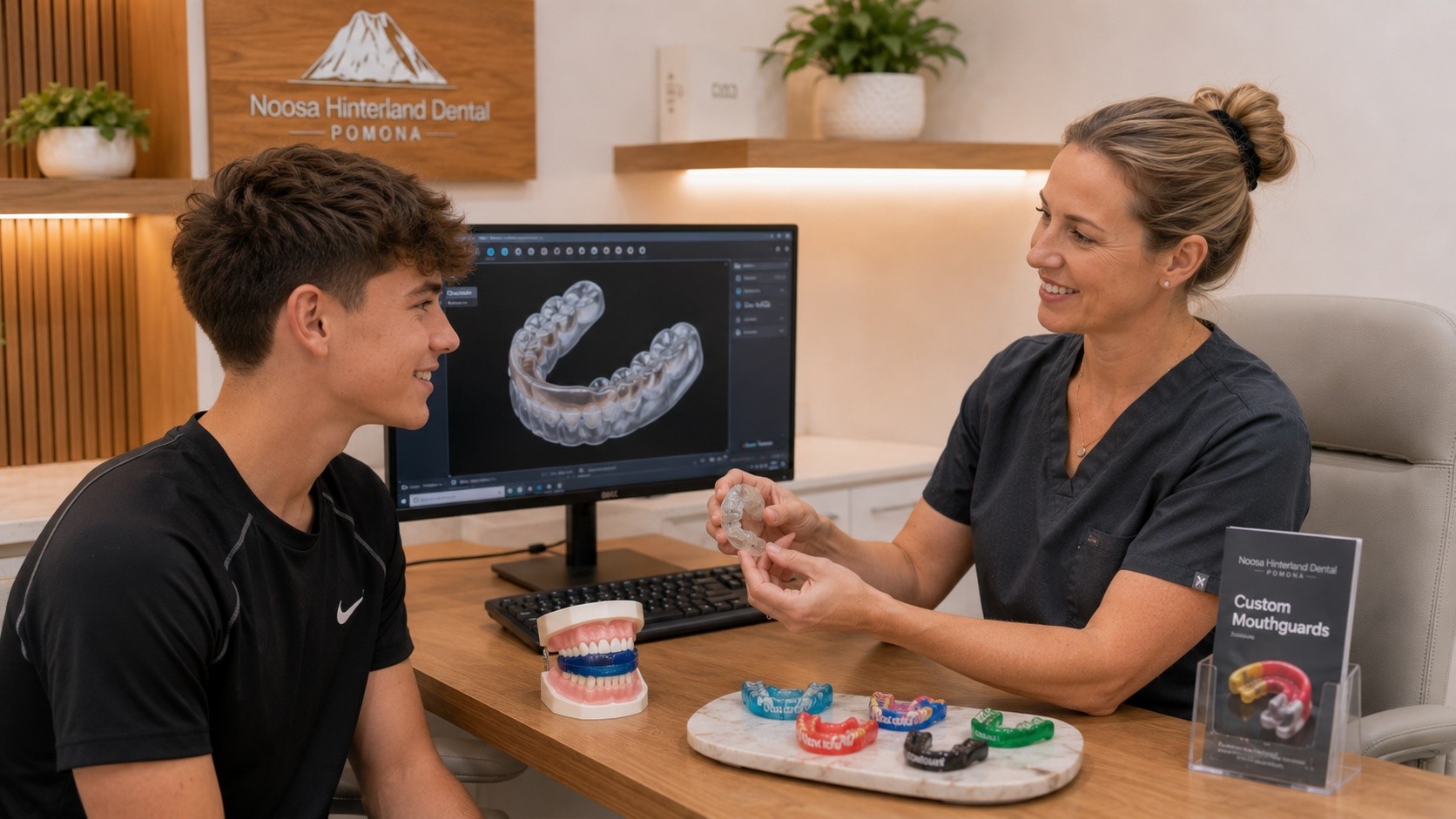
For non contact sport, teens often keep aligners in place. For contact sport such as rugby or AFL, a custom mouthguard from Noosa Hinterland Dental protects teeth, and trays can come out during play. Aligners go straight back in afterwards so treatment stays on schedule.
Music and performance
Many teenagers keep aligners in while playing string, keyboard or percussion instruments. For wind or brass instruments, your dentist can discuss whether short practice sessions without trays are better, and how to balance this with required daily wear time.
Caring For Invisalign Aligners
Teens rinse trays in cool water when they come out and gently brush them with a soft toothbrush and mild soap. Hot water and harsh cleaners can warp or scratch the plastic, so those are avoided.
Simple rules your teen can follow include:
-
Always store aligners in a hard case, not in a pocket or tissue
-
Keep trays away from hot drink cups and car dashboards
-
Rinse aligners before putting them back in
-
Avoid coloured mouthwashes that may stain trays
After treatment, retainers worn at night help hold the new positions through the later teen years and into adulthood.
How Long Does Invisalign Treatment Take?
Most teen Invisalign cases fall within roughly 6 to 18 or more months. The time frame depends on:
-
How crowded or spaced the teeth are
-
Whether the bite needs correction as well as straightening
-
How carefully the teen wears the aligners
-
Whether extra aligners (“refinements”) are needed near the end
Orthodontics Australia suggests many orthodontic treatments, including braces, often run for 18 to 24 months. Some simple Invisalign cases finish sooner, while more complex bites can take a little longer.
At Noosa Hinterland Dental, your dentist gives a personalised estimate after digital planning and explains what could shorten or extend that estimate — factors explored in depth by an evaluation of the number of aligners needed to correct various malocclusion traits. Parents and teens are encouraged to ask questions so everyone understands the expected timeline.
Moving Forward With Your Teen’s Smile
Invisalign for teens can offer a discreet, flexible way to guide teeth into better positions when your child wears the trays as directed. For many families around the Noosa Hinterland region, this fits well with busy school, sport and social schedules. At the same time, braces remain very important for teenagers with more complex bite or jaw problems.
Noosa Hinterland Dental in Pomona takes the time to listen, examine and explain every option in plain language. Families from Pomona, Cooran, Cooroy, Kin Kin, Imbil and surrounding areas can discuss treatment goals, costs and payment plans, knowing the advice centres on what suits their teen’s health and wellbeing.
Conclusion
To wrap up, clear aligners such as Invisalign for teens suit many teenage smiles, while braces still suit some difficult cases better. The best way to decide is a careful orthodontic assessment with a trusted local dentist who understands both options and your child’s personality. With the right plan and support, your teen can move towards a straighter, healthier smile with confidence.
Frequently Asked Questions
Question: What Is Invisalign For Teens And How Is It Different From Adult Invisalign?
Invisalign for teens uses the same clear aligner technology as adults but includes teen friendly features. These can include wear indicators, space for erupting teeth and replacement trays if some are lost. Treatment plans also consider growth more closely, especially jaw development and remaining baby teeth.
Question: At What Age Can A Teenager Start Invisalign Treatment?
Teens usually start Invisalign once most permanent teeth are present, often around early to mid high school. The exact timing depends on growth and bite. An early orthodontic check at Noosa Hinterland Dental helps plan ahead and pick the best time to start.
Question: How Long Does Invisalign Treatment Typically Take For Teenagers?
Most teen Invisalign cases fall within roughly 6 to 18 or more months. Simple spacing may finish sooner, while complex bites take longer. After assessment and digital planning, Noosa Hinterland Dental gives a personal estimate and explains what may affect the length of treatment.
Question: Is Invisalign As Effective As Braces For Teen Orthodontic Treatment?
Invisalign can be very effective for many mild to moderate alignment and bite issues. Some severe or unusual problems still suit braces or combined care better. Your dentist recommends the safest, most predictable path based on your teen’s teeth, bite and habits.
Question: How Much Does Invisalign For Teens Cost In Australia?
Invisalign teenager cost in Australia depends on case complexity and treatment length. No two mouths are the same. At Noosa Hinterland Dental, fees are explained clearly, with flexible, interest free DentiCare payment plans to spread costs. You will receive a written quote before starting.
Question: Will Invisalign Aligners Affect My Teen’s Speech Or Eating?
Most teens notice a slight lisp for a few days only. Speech usually settles quickly as they adapt. Aligners come out for meals, so eating feels normal, but teeth should be brushed or at least rinsed before trays go back in to protect enamel and keep aligners clear.
Question: Can My Teen Play Sport Or A Musical Instrument With Invisalign?
Yes, most teens play sport and instruments successfully with Invisalign. Trays usually stay in for non contact sport. For contact sport, a custom mouthguard is used, and your dentist advises how to manage trays around training and games. For wind and brass instruments, short periods without trays may be fine if wear time still reaches 20 to 22 hours per day.
Question: What Happens If My Teen Forgets To Wear Their Aligners Enough?
If aligners are not worn enough, teeth may lag behind the digital plan. Treatment can slow or backtrack. The dentist may repeat some trays, adjust the schedule and coach your teen on improving routines. In very inconsistent cases, switching to fixed braces might be discussed.
Question: Do Teens Still Need Retainers After Invisalign Treatment?
Yes, retainers are needed after any orthodontic treatment, including Invisalign. They hold teeth in their new positions while bone and gums settle. Noosa Hinterland Dental explains the best retainer type and wear schedule, often nights only after an initial full time period.
Question: How Do I Book An Invisalign Assessment At Noosa Hinterland Dental?
You can contact Noosa Hinterland Dental’s Pomona practice by phone or through the website booking form. The clinic welcomes families from Pomona, Cooroy, Cooran, Kin Kin, Imbil and nearby Noosa Hinterland communities. A friendly consultation starts the conversation about your teen’s smile and whether Invisalign for teens or braces is the better choice.